How to Tell If Your AC Technician Is Giving You an Honest Diagnosis
An honest AC technician shows you measurements, explains what they found in plain language, offers more than one option when appropriate, and never pressures you into an immediate decision on a major repair. If a technician diagnoses your system in under 15 minutes, quotes a single lump-sum price without itemization, and pushes urgency on a repair that costs more than $500, you have reason to slow down and get a second opinion before authorizing any work.
The HVAC industry has a trust problem, and homeowners know it. National surveys consistently rank HVAC among the home services most likely to involve unnecessary upsells or inflated repair quotes. Part of the problem is that the work happens inside complex equipment that most homeowners cannot evaluate themselves, which creates an information imbalance that dishonest operators exploit. But the gap between a trustworthy technician and a dishonest one is not actually hard to spot once you know what to look for. The signals are consistent, and they start before anyone touches your equipment.
What a Legitimate Diagnostic Looks Like
A proper AC diagnostic is not a glance-and-quote visit. It is a systematic evaluation that follows a logical sequence, and any technician worth hiring should be able to walk you through what they are doing and why.
The process starts at the thermostat. A good technician verifies your thermostat settings, checks that the unit is calling for cooling correctly, and confirms that the temperature differential between the setpoint and the actual room temperature matches what you have been experiencing. This takes two minutes and establishes a baseline before they touch the equipment.
Next comes the indoor unit. The technician should inspect the air filter condition, check the evaporator coil for ice or dirt buildup, measure the temperature of the air entering and leaving the coil (called the temperature split or delta T), and listen for unusual sounds from the blower motor. In Savannah’s climate, a healthy system should produce a temperature split of 15 to 22 degrees Fahrenheit between the return air and the supply air. A split below 14 degrees suggests low refrigerant, a dirty coil, or airflow restriction. A split above 22 degrees can indicate low airflow from a failing blower motor or severely clogged filter.
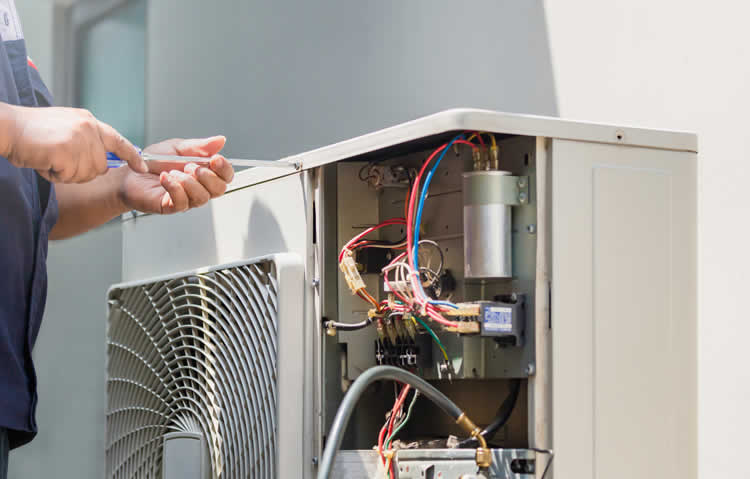
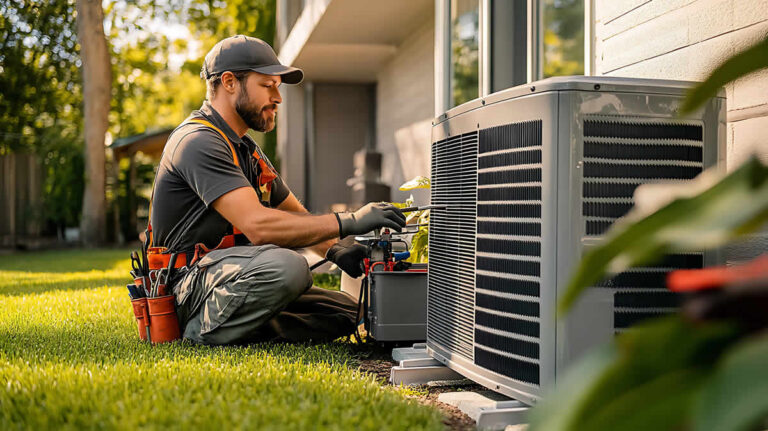
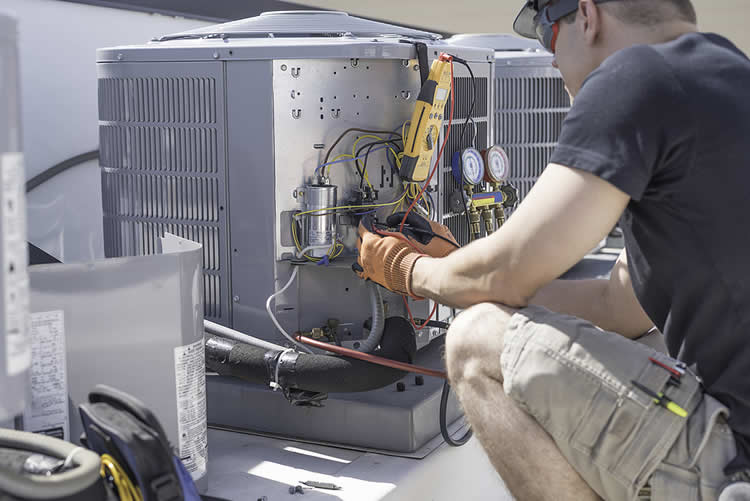
Then the outdoor unit. A thorough technician inspects the condenser coil for dirt and debris, checks the condition of the contactor and capacitor with a multimeter, measures the amperage draw on the compressor against the rated load amps listed on the data plate, and checks refrigerant pressures on both the high and low side using a manifold gauge set. In the Pooler and Savannah area, where salt air and pollen accumulation on condenser coils are constant issues, a visual inspection of coil condition is especially important.
This full process takes 30 to 60 minutes on a standard residential system. A technician who spends 10 minutes, does not pull out a multimeter or gauge set, and confidently diagnoses a major component failure is either cutting corners or has already decided what they are going to sell you before they arrived.
Red Flags That Suggest a Dishonest Diagnosis
No single red flag guarantees dishonesty — some are just signs of a technician who is rushed or poorly trained. But when multiple flags appear in the same service call, your skepticism is warranted.
The technician will not show you what they found. An honest technician wants you to understand the problem because an informed homeowner is easier to work with than a suspicious one. If they measured a bad capacitor, they should be able to show you the multimeter reading compared to the rated value printed on the capacitor itself. If they found low refrigerant, they should show you the gauge pressures and explain what the numbers mean. A technician who tells you the diagnosis but refuses to show you the evidence is asking you to trust them without verification, and trust without verification is not something you should extend to someone you just met.
The quote is a single number with no breakdown. Professional HVAC companies quote repairs with at least three visible components: the diagnostic fee, parts cost, and labor. Some use flat-rate pricing where labor is built into the repair price — that is fine, but the flat rate for a specific repair should still be identifiable. A technician who says “it’s going to be $1,800 to fix it” and cannot or will not separate that into parts, labor, and refrigerant costs is making it impossible for you to evaluate whether the price is fair. That opacity benefits only one party, and it is not you.
They push extreme urgency on non-emergency repairs. There are genuine HVAC emergencies — a gas leak, a cracked heat exchanger producing carbon monoxide, an electrical fault that poses a fire risk. These warrant immediate action. A bad capacitor does not. A worn contactor does not. Even a weak compressor that is still technically running does not require a same-day decision on a $2,000 repair. If a technician tells you that you must decide right now or the price goes up, or that your system will suffer catastrophic damage if you wait 48 hours to get a second quote, they are using pressure tactics, not providing professional advice. Legitimate urgency does not require a sales pitch.
They diagnose expensive failures without testing cheaper possibilities first. This is the most costly red flag for homeowners. A compressor that will not start could be a $1,800 compressor replacement — or it could be a $200 capacitor that is not sending the start signal. A system blowing warm air could need a $1,500 evaporator coil — or it could have a $150 contactor that is not engaging the compressor. The diagnostic sequence matters because cheaper components fail more frequently than expensive ones, and a competent technician tests the inexpensive possibilities before concluding that the expensive component is dead.
If a technician jumps straight to “you need a new compressor” without first verifying that the capacitor, contactor, and electrical connections are functioning correctly, you are either dealing with someone who lacks diagnostic skills or someone who profits more from the larger repair. Neither scenario serves you well.
They recommend full system replacement on a system under 8 years old. Barring catastrophic damage from flooding, lightning, or manufacturing defects, a properly installed AC system under 8 years old should be repairable at a cost that makes financial sense. A technician who pushes full replacement on a relatively new system is either misjudging the economics or earning a commission on equipment sales that exceeds their repair revenue. This is not to say that young systems never need replacement — manufacturing defects and botched installations happen — but the bar for recommending replacement on a newer system should be very high, and the technician should be able to articulate exactly why repair is not viable.
How to Evaluate a Repair Quote
You do not need HVAC expertise to evaluate whether a quote is reasonable. You need about 15 minutes and a willingness to ask direct questions.
Start by asking what specific part is being replaced and what brand it is. Look up the retail price of that part on a supplier website like RepairClinic, Amazon, or Grainger. HVAC companies mark up parts — typically 40-100% over wholesale — and that markup is legitimate because it covers their inventory costs, warranty on the work, and the expertise to select the correct part. But knowing the retail price gives you a reference point. If a part retails for $80 and you are being quoted $400 for just the part before labor, that markup is aggressive and worth questioning.
Ask whether the quoted part is OEM or aftermarket. OEM parts come from the original equipment manufacturer and are guaranteed compatible but cost more. Aftermarket parts from reputable manufacturers often perform identically at lower cost. A good technician should be able to offer both options and explain the tradeoff, not default to whichever is more expensive without disclosing the alternative.
For any repair over $500, get a second opinion. This is not an insult to the first technician — it is standard practice that any confident professional should welcome. A second diagnostic fee of $75 to $150 is cheap insurance against a $1,500 misdiagnosis. And the second technician does not need to know what the first one said. Give them a clean slate and see whether they arrive at the same conclusion independently. If both technicians diagnose the same problem and their quotes are within 20-25% of each other, you can proceed with confidence.
What Good Communication Looks Like
Beyond the technical diagnosis, the way a technician communicates tells you a lot about whether they are working in your interest or their own.
An honest technician presents options rather than directives. Instead of “you need a new compressor,” they say “your compressor is showing signs of failure — here is what replacement costs, here is what the system is worth, and here is how I would think about the decision.” The difference is subtle but significant. The first phrasing positions the technician as the decision-maker. The second positions you as the decision-maker with the technician providing expert input. The best technicians in the industry operate this way because they understand that informed homeowners who make their own choices become loyal, long-term customers — which is worth far more than one inflated repair invoice.
An honest technician also tells you when something is not wrong. If they inspect your system and find that the capacitor is within spec, the refrigerant pressures are normal, and the problem is actually a dirty filter that you can replace yourself for $8, they should tell you that — even though it means the service call generates minimal revenue. A technician who finds problems on every single visit, every single time, regardless of system age or maintenance history, is either extraordinarily unlucky or extraordinarily dishonest.
Pay attention to how they discuss your system’s age. A trustworthy technician acknowledges the remaining useful life of a well-maintained system rather than treating every unit over 10 years old as a replacement candidate. Conversely, they are honest when a system is genuinely at end-of-life rather than stringing you along with repair after repair to collect service fees. The balance between these two extremes is where professional integrity lives.
The Savannah-Specific Angle
In the Greater Savannah market, a few local factors are worth keeping in mind when evaluating a technician’s honesty.
Salt air corrosion on condenser coils is a real and accelerated problem for homes east of I-95, particularly on Tybee Island, Wilmington Island, and in the Thunderbolt area. A technician who points out salt corrosion on your outdoor unit is not inventing a problem — but the appropriate response is coil cleaning and a protective coating application, not necessarily a full condenser replacement. If corrosion has caused active refrigerant leaks through the coil, replacement becomes necessary, but a technician should be able to show you the specific leak points rather than gesturing at general corrosion and quoting a new unit.
Humidity-related issues are similarly real but sometimes overstated. Yes, Savannah’s humidity puts extra load on your system and can cause problems like frozen coils, algae-clogged drain lines, and mold growth on evaporator coils. But these are maintenance issues with maintenance-level solutions, not crises that require emergency equipment replacement. A technician who uses humidity as a scare tactic to justify a major sale is misrepresenting a manageable condition as an urgent one.
Storm damage claims also warrant scrutiny. After a significant thunderstorm or hurricane event, some operators canvas affected neighborhoods and diagnose “surge damage” on systems that were functioning normally. Power surges do damage HVAC equipment — capacitors and circuit boards are especially vulnerable — but a legitimate surge damage diagnosis should include specific electrical measurements showing component failure, not just a visual inspection and a declaration that the compressor “took a hit.”
How Carriage Approaches Diagnostics
At Carriage Heating & Cooling, every diagnostic includes multimeter readings on electrical components, manifold gauge pressure measurements on the refrigerant system, and a temperature split measurement at the air handler. We photograph what we find and walk homeowners through the readings so you can see the evidence behind our diagnosis. We quote flat-rate pricing with visible parts and labor components, and we never charge differently based on whether you accept the repair on the spot or call us back after getting a second opinion.
If you have received a repair quote that feels off, or you want an independent evaluation of your system before making a decision, call us at (912) 306-0375. We serve Pooler, Savannah, Richmond Hill, Rincon, and the surrounding communities, and we are comfortable being the second opinion in any situation.